Burnout, Perimenopause, or Depression? How to Tell and What to Do
You’re mid-workout, and instead of the usual endorphin rush, you feel a heaviness in your legs that matches the weight in your mind. Or maybe you’re snapping at your partner over small things, losing sleep despite feeling exhausted, or staring at your training plan with a sense of dread rather than excitement.
For female athletes in their 40s, these feelings are often dismissed as "just a bad week" or "part of the grind." But when the bad week turns into a bad month, you start looking for answers. The problem? The answers are often messy.
The symptoms of athletic burnout, perimenopause, and depression overlap in frustrating ways. Fatigue, mood swings, and sleep issues are common to all three, creating a web of confusion that’s hard to untangle alone.
Are you training too hard without enough recovery? Are your hormones shifting as you enter a new biological phase? Or is there a deeper mental health concern at play?
Understanding the distinctions isn’t just about labeling what’s wrong; it’s about empowering yourself to find the right solution. This isn’t a diagnostic manual, but rather a guide to help you build self-awareness, have better conversations with your healthcare providers, and ultimately, reclaim your performance and joy.
The Overlap: Why It’s So Confusing
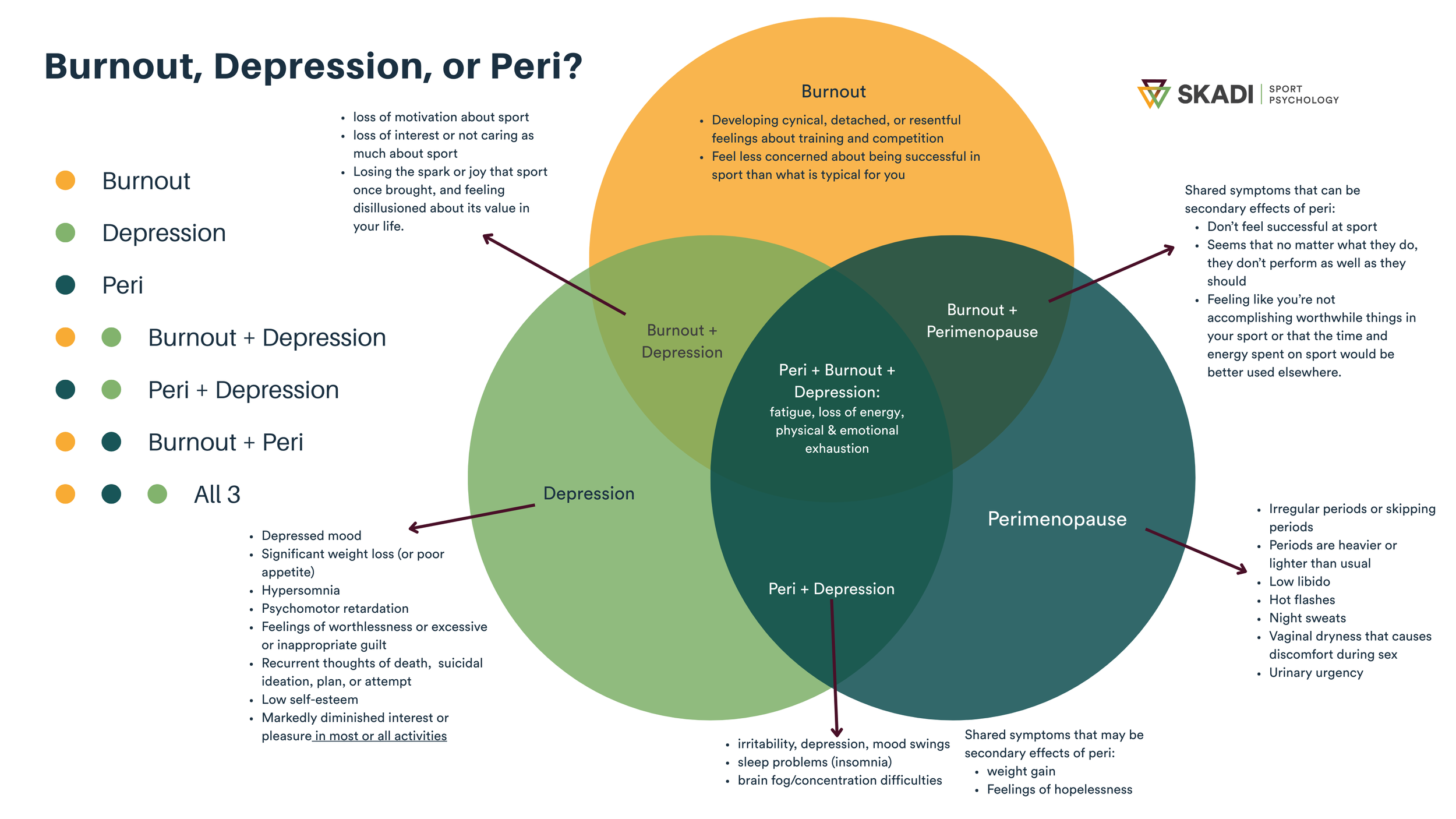
Imagine a Venn diagram with three circles: Athletic Burnout, Perimenopause, and Depression.
In the center, where all three meet, sits a heavy, dark cloud of fatigue. Whether it’s physical exhaustion from training, the deep weariness of depression, or the sleep-deprived fog of perimenopause, being tired is the universal signal that something is off.
The overlaps then continue:
Burnout & Perimenopause: Both can wreck your sleep. Burnout often leads to "tired but wired" insomnia, while perimenopause brings night sweats that jolt you awake.
Perimenopause & Depression: Hormonal shifts can trigger mood swings and irritability that mimic depressive symptoms.
Burnout & Depression: Both strip away your motivation and sense of accomplishment.
Because these conditions share so much DNA, it’s crucial to look at the unique symptoms—the outliers—to understand what’s really going on.
Athletic Burnout: When the Fire Goes Out
Athletic burnout is specific. It is a state of physical, emotional, and mental exhaustion tied directly to your sport. It usually stems from chronic stress—high training loads, performance pressure, or lack of autonomy—without adequate recovery.
Unlike depression, which casts a shadow over your entire life, burnout tends to stay in its lane. You might dread going to the track, yet still look forward to dinner with friends.
Key Symptoms Unique to Burnout:
Performance-Related Fatigue: You feel wiped out specifically by the demands of your sport. The thought of training feels heavier than the training itself.
Devaluation of Sport: You might find yourself thinking, "Why am I even doing this?" or feeling like the effort isn't worth the reward.
Cynicism: A negative or detached attitude toward training, coaches, or competition.
Stagnant Performance: No matter how hard you push, you don't seem to improve. You feel like you're not performing up to your ability, leading to a decreased sense of accomplishment.
What the Research Says:
Research indicates that burnout often arises when athletes feel a lack of control or autonomy in their training. It’s also linked to "obsessive passion," where your identity is so wrapped up in being an athlete that you can’t step away, even when your body is screaming for rest.
If this sounds like you, check out our guide on From Burnout to Breakthrough in Weeks to start shifting your mindset.
Perimenopause: The Hormonal Shift
Perimenopause is the transition phase leading up to menopause. It typically starts in a woman’s 40s but can begin in the late 30s. During this time, estrogen and progesterone levels fluctuate wildly, which can wreak havoc on your internal thermostat, circadian rhythm, and mood regulation.
For endurance athletes who are used to their bodies performing like clockwork, this unpredictability can be jarring.
Key Symptoms Unique to Perimenopause:
Cycle Changes: Irregular periods are the hallmark sign. Your cycle might become shorter, longer, heavier, or lighter.
Hot Flashes & Night Sweats: Sudden waves of heat, or waking up drenched in sweat? These are classic indicators.
Vaginal & Urinary Changes: Dryness or increased urgency to use the restroom are physical signs unreated to training stress or mood disorders.
Physical Body Changes: You might notice shifts in body composition or difficulty maintaining muscle mass despite consistent training.
It’s easy to mistake the fatigue of perimenopause for overtraining. However, if your tiredness is accompanied by irregular cycles or night sweats, hormones are likely a primary driver.
Depression: The Pervasive Cloud
Depression is a psychological mood disorder, not a reaction to a bad race or a hard training block. It affects how you feel, think, and handle daily activities.
The critical distinction here is the pervasiveness. While burnout makes you hate running, depression might make you indifferent to running and reading and spending time with family.
Key Symptoms Unique to Depression:
Anhedonia: This is the clinical term for a markedly diminished interest or pleasure in most or all activities, not just sport.
Feelings of Worthlessness: You may struggle with excessive guilt or feel like a failure as a person, not just as an athlete.
Global Low Mood: A depressed mood that persists for most of the day, nearly every day.
Thoughts of Death: Recurrent thoughts of death or suicide are serious symptoms that require immediate professional attention.
Depression creates a distorted view of reality where hope feels inaccessible. If you are experiencing these symptoms, please prioritize seeking help from a licensed mental health professional.
Read more about How to Find a Sport Psychologist or therapist who understands athletes.
Mapping Your Symptoms: A Practical Framework
To help you gain clarity, let’s consolidate the symptoms into a checklist. Grab a notebook and see where your experiences cluster.
Is it Burnout?
I feel physically worn out specifically from sport participation.
I question the value of my sport and feel like I’m not achieving much.
I have negative, cynical feelings toward my training.
I feel like I’m not performing up to my ability, no matter the effort.
Is it Perimenopause?
My periods have become irregular, heavier, or lighter.
I experience hot flashes or night sweats.
I have noticed vaginal dryness or urinary urgency.
My libido has dropped significantly.
Is it Depression?
I have lost interest in hobbies and activities I usually love (outside of sport).
I feel sad, empty, or hopeless most of the day.
I feel worthless or excessively guilty.
I have recurrent thoughts of death or suicide.
Note: If you check boxes in multiple categories, that is common. You can be burned out AND perimenopausal. You can be perimenopausal AND depressed. This complexity is why professional support is so valuable.
Actionable Steps for Recovery and Management
Once you have a better idea of what you’re dealing with, you can take targeted action.
If It’s Burnout: Restore Autonomy and Rest
Burnout requires a shift in how you engage with your sport.
Prioritize Rest: This doesn't just mean a day off. It might mean a week off, or a season of "active play" without structured training. Want some extra resources and guidance? See How to Incorporate Rest and Recovery in Training.
Change the Stimulus: If you’re a runner, try swimming or climbing. Remind your body what it feels like to move for fun, not for data.
Check Your "Why": Reconnect with intrinsic motivation. Why did you start this sport? If the answer is lost in pursuit of PRs, it’s time to recalibrate.
If It’s Perimenopause: Track and Adapt
You can’t control your hormones, but you can manage their impact.
Track Everything: Use an app to track your cycle and symptoms. This data is gold for your doctor.
Focus on Sleep Hygiene: Keep your room cool and consider moisture-wicking sheets for night sweats.
Adjust Training: Your body might need more recovery time between hard sessions. Strength training becomes non-negotiable for bone density and muscle mass. See our article on Strength Training for Endurance Athletes for guidance.
If It’s Depression: Seek Professional Care
Depression is a medical condition that responds well to treatment.
Therapy: Cognitive Behavioral Therapy (CBT) and similar modalities (like Acceptance & Commitment Therapy) are highly effective.
Medication: Antidepressants can be a vital tool for many people. There is no shame in using chemistry to balance chemistry.
Compassionate Movement: If training feels impossible, just move gently. A walk outside can help regulate mood without the pressure of "performance."
When to Seek Help
We often try to "tough it out." We tell ourselves we just need to be more disciplined or try harder. But mental health and hormonal health are not matters of willpower.
If your symptoms are affecting your daily functioning, your relationships, or your ability to enjoy life, it is time to call in the experts.
Consult a Physician: To rule out thyroid issues, iron deficiency, and to discuss hormone therapy if perimenopause is the culprit.
Consult a Mental Health Professional: To help untangle the emotional web and provide coping strategies.
Talk to Your Coach: A good coach will adjust your plan to support your health, not just your race times. Open communication is key to preventing burnout from deepening.
You Are Not Broken
It is easy to feel like your body is betraying you when performance stalls or mood plummets. But these symptoms are simply data. They are signals from your body asking for a change in pace, care, or perspective.
Take a moment to pause and appreciate that you get to go on a quest to see how good you can be—and that includes navigating the messy, imperfect chapters. You are not broken; you are a complex human being navigating a complex phase of life.
Listening to these signals is not a sign of weakness. It is the ultimate display of athletic intelligence. By understanding the differences between burnout, perimenopause, and depression, you are taking a powerful step toward sustainable performance and long-term well-being.
Ready to Dig Deeper?
For a more in-depth conversation on this topic, listen to the "Hit Play Not Pause" podcast where Dr. Ayala discusses "Is it Burnout or Perimenopause? How to Tell (and What to Do About It)." It’s a must-listen for any female athlete navigating these waters.
If you need personalized support to untangle your symptoms and build a mental performance plan that actually works for your life, we are here to help. Explore Skadi’s 1:1 Individual Sessions to schedule your free discovery call.