If you are a woman in triathlon (or you coach them), you’ve probably gotten wind of IRONMAN’s new Woven campaign, which launched recently. The day after the launch, I posted a summary of the comments sections on social media, as well as my general thoughts about the campaign. Today, I’m rolling up my sleeves (some more!) to talk you through what this campaign actually is, the green flags I see, and why I’m hopeful about what it means for the future of women in triathlon.
For those of you who are new here, I’m a sport psychologist who specializes in work with women and non-binary endurance athletes. I’ve spent the last decade researching what makes race environments feel safe, equitable, and worth coming back to. I’m also one of Woven’s expert ambassadors, which gives me a front-row seat to a lot of the action.
Photo by Sander Hallaste on Unsplash
What Woven is: IRONMAN’s plan to close the gender gap in triathlon
In short, Woven is IRONMAN’s initiative to address the gender gap you notice at any expo or start line. The initiative was informed by a global survey that IRONMAN sent to over 10,000 female endurance athletes in 97 countries. They distributed the results of this survey in April of 2025, and have been actively working toward the Woven campaign behind the scenes since then.
Their Action Strategy outlines their game plan for the campaign. It notes that women made up 24% of IRONMAN 70.3 starters and 18% of full-distance starters in 2025. (Notice how the gap widens as the distance grows? There’s a reason for that!).
Woven wants to work toward 50% women at the start line. To do so, it’s focusing on three pillars: visibility, because you need to see it to be it; product and race experience, because friction and an unwelcome environment keep women out; and community, because belonging turns interest into participation.
It’s one thing to talk about pillars. It’s another thing to actually see them in action.
1.Visibility
The first pillar, visibility, is noticeable from the start: the website, their marketing, and their ambassadors represent a wide range of ages, body sizes, cultural identities, and speeds. Woven is also prioritizing a range of IRONMAN stories to demonstrate the journeys women take to triathlon: a first 70.3 finish on the fourth try, recovery from an eating disorder, racing Kona in a daughter’s memory, and more. This kind of representation matters more than it might seem. As we explore in our guide to size inclusion in endurance sports, athletes stay in sports where they can see themselves, and they quietly exit the ones where they can’t.
2. Race Experience
The second pillar, which focuses on the race experience, will be addressed via The Start Line Project (amongst other initiatives). This project is a two-year effort that directs Woven’s energy toward six IRONMAN 70.3 events: New Zealand, Rockford, Jönköping, Oregon, Emilia-Romagna, and North Carolina. Woven specifically selected these races for geographic diversity and strong existing women’s participation. The goal here is essentially proof of concept. Women at those races will receive priority registration, ambassador-led meetups, and event-specific webinars, plus training challenges and race-week activities. IRONMAN has committed to posting participation numbers from all six of these events (Green flag! Transparency with data is huge.). There are already a number of other events on the calendar for the remaining 2026 events: cheer zones, drop-in clubhouse hours open to all women, a session on open-water anxiety (as a sport psychologist, this is HUGE! We need this!), and a Kona panel with Jessie Diggins and Courtney Dauwalter. That open-water anxiety session deserves an extra note, because fear and anxiety on race day are among the most common reasons capable athletes underperform their fitness, and normalizing that conversation at the race itself is a meaningful shift.
3.Community
Onto the third pillar, which is the year-round component. The Woven Strava group is private and women-only, which women can access by invitation when they register. To make sure they’re collaborating with others doing this work (and not simply reinventing the wheel in their own silo), Woven has also linked the campaign to other events and communities who are actively supporting women in endurance sport. The online community will also get opportunities to meet one another in person — whether virtually via webinars (including mine) or via social runs and meetups in Madrid, New York City, and New Zealand. Community is doing heavy lifting here, and rightly so. We know from both research and lived experience that belonging is one of the strongest predictors of whether athletes stay in sport, and a private, moderated, women-only space is a deliberate design choice, not an accident.
A number of women have asked about timeline. They’re playing the long game here, and they know it. Woven has identified three core phases: test, learn, and evolve through 2028; scale what works through 2033; and dream big after that. It’s important to note that we’re in the first phase, which means most of what Woven does right now is designed to be measured and adjusted. This is another green flag; they’re focused on this being an iterative process, rather than a checklist of things to get “right.”
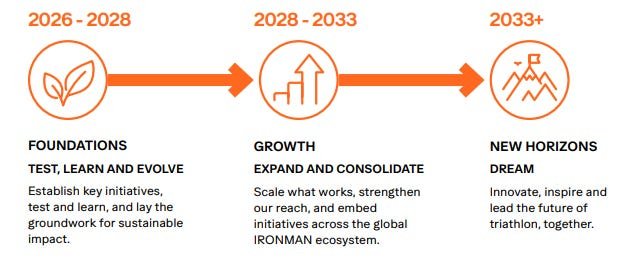
Click here to access the strategy plan for Woven
When we put all of these pieces together, they create a lovely loop: you see someone like you, you find a race that prioritizes you before registration even opened, and you find a community that clearly wants you to stay well after the finish line.
The green flags: what Woven is getting right for female triathletes
A number of people have asked me what I think of the campaign, while recognizing I’m one of Woven’s expert ambassadors. In short, I’m incredibly hopeful and I think they’re doing A LOT of things well here. I wouldn’t have agreed to join this team if I didn’t trust they were going to do everything they could to truly move the needle for women in triathlon.
First, Woven clearly notes that time is one of the biggest barriers. My research also supports this. Women are balancing training against work, family, and the mental load of LIFE. Though we can’t exactly restructure society to give women more time in the day (one can dream…), Woven is creating achievable pathways as stepping stones. They’re not encouraging all women to register for a 140.6 they don’t have time to train for. Rather, they’re making room for relay and short-course entry points in an effort to “recognize the complexity of a woman’s lifestyle.” I appreciate this realistic approach to the number one barrier women face.
A second green flag is one of Woven’s six principles: “build with women, not just for women.” For anyone who’s done work in participatory action research, we know that community has to come first. There’s no point in creating a plan if the community of interest doesn’t actually have a voice in shaping it. Woven’s research found that two thirds of existing IRONMAN athletes learned about triathlon from friends or family (like me!), so a community designed around peer-to-peer connection is a strategic play. We need to see ourselves in the mix and we need to feel that we have a voice in the matter. They’re working on both here.
One of Woven’s other six principles is “do not assume long-course triathlon ambition from the outset.” (YES! THIS!!) Woven knows that the motivations to pursue triathlon include health and fitness, personal achievement, testing physical limits, endorphins, and prioritizing mental health. Dr. Candace Brown has also done some good work in this space and researched the motivations of women in triathlon, which you can read about here. When we combine that principle with “progress over perfection,” we focus on the beautiful and humbling (and messy) process of showing up for ourselves consistently, rather than the podiums, PRs, or outcomes.
I think it’s also important to recognize that IRONMAN’s policy groundwork and scorecards exist. Do they have work to do? Absolutely. Have they made mistakes? Absolutely. AND they continue to learn from said mistakes and show up. They’ve had equal pro prize money since 1986. In 2022, they moved to equal professional slot allocation. And in 2024, they launched a Pregnancy and Parenthood policy with deferrals of up to two years, flexibility for partners, and coverage for adoption and surrogacy. As a researcher, I’m also glad they have a measurement plan to support this work: minimum event standards, participant satisfaction split by gender, women’s sentiment and NPS, marketing representation, retention, and referrals. Splitting satisfaction data by gender is the move I most want other race organizers to copy. You can’t address an experience you never disaggregate, and if 75% of finishers are men, the experiences of women won’t actually reveal themselves unless you look at them intentionally. This measurement mindset mirrors what current research says women’s sport psychology needs more of, which is another reason this campaign feels different.
IRONMAN also knows that the journey of a woman in triathlon doesn’t start when she signs with her coach or uploads her training plan into TrainingPeaks for the first time. It starts when a woman goes to volunteer for a race her friend is doing, gets goosebumps watching the start of the swim at IRONMAN Lake Placid, and thinks to herself, “Whoa. This is incredible.” (That was my journey!) It starts when a woman flies across the country to support her son and her daughter-in-law for their first IRONMAN and thinks, “I could never!” but sees other women in their 60s and 70s doing it. (A few years later, my mother-in-law took on IRONMAN Arizona at the young age of 65. This next season, we’re training together for a 70.3.)
The expert roster includes specialists in sport psychology, coaching, nutrition, menstrual cycle physiology, menopause, and injury recovery. As expert ambassadors, we’re working with IRONMAN to create a comprehensive library of articles specifically for women. In these articles, we’re covering the topics women ask coaches and psychologists about in real life, and plenty of the sport’s resources skip. Another fun fact: they’re intentionally writing the articles for every stage of triathlon (and life).
Finally, the community is built to be safe. Woven’s rules of engagement treat the community as something to protect. Hate speech, bullying, and discrimination are out; healthy debate stays in; IRONMAN team members help moderate. Privacy gets real attention too: what’s shared in the group stays in the group. IRONMAN pledges to use only anonymized, aggregated insights from conversations, and it won’t share individual posts or personal information outside the group without permission. Those commitments matter in a space where women talk about bodies, training, and the mental load.
Photo by Ollie Danvers on Unsplash
What I’m still watching
These are the questions I’m carrying into the next few years, and what I’ll be actively helping them work toward:
Let’s create a nuanced scoreboard. Woven’s primary KPI in this first phase is ultimately community growth and engagement. Woven plans to provide participation updates for the 6 Start Line Project races, which is a great sign. As a data nerd, I’d also love to see the percentage of women registering, deferring or withdrawing, and DNFing. Registration rates and finishing rates are an important part of the picture, but they’re only a small part of the story.
Women’s Kona slots! YES, this is a hot topic (especially this week)! We all know at this point that IRONMAN is returning to a single day of racing in Kona. There have been some understandable concerns regarding slot allocation, which arguably reinforce gender disparities in this sport. The Woven plan doesn’t yet state how their new slot allocation system will affect the number of women’s slots. I’d love to see slot counts by gender across the next few seasons to see how (and to what extent) we’re moving the needle here. 50/50 at Kona would be amazing.
Will gender-expansive inclusion reach the fine print? One of Woven’s principles says that if you identify as a woman or non-binary person, you are welcome here. As someone who works with much of the trans+ community, including non-binary athletes, seeing this is a HUGE start. All too often, race websites and campaigns conveniently avoid questions about trans and non-binary athletes, so I give Woven credit here. That said, this needs to be carried into safeguarding policy, changing-room and facility standards, and race communications that clearly outline policies for non-binary and trans+ athletes directly. For example, the rules of engagement call the private Strava group a community for women and point to the Woven Terms and Conditions for eligibility criteria. Those criteria then direct people to email IRONMAN directly if they don’t identify as a woman but still want to get involved. So what does this really mean for non-binary athletes? And what about the trans women? The athletes I work with read the fine print before they register for anything (usually), so Woven needs to make sure all of the communication here is in alignment, and they need to have policies to back it. We’ve written about what real support systems for trans and non-binary athletes require, and it always comes down to exactly this: the fine print has to match the headline.
Who sets the standard? The race-experience pillar notes the importance of women-specific facilities and minimum event standards. The Start Line Project page covers community activities, education, and race-week events in detail, which is great. That said, it says little about facilities and safeguarding — likely because Woven understands this is a work in progress and it will take time to be really thoughtful and intentional about safeguarding. Regardless, those standards should sit right alongside the programming.
How does the community talk about bodies and food? This might feel like a random piece, but as a sport psychologist, it’s one I want to keep an eye on. Woven’s rules ban misinformation and expect members to keep conversations focused on wellness, fitness, personal growth, and women’s experiences in sport. I’d love to see norms that keep diet-culture language out of a space where female athletes share their training, fueling, and body image woes. Far too many women are affected by disordered eating, race weight talk, and body dissatisfaction. If we truly want a space that’s supporting women, we need to be clear about what is (and what is not) deemed acceptable.
Why I’m hopeful about the future of women in triathlon
I really do think Woven is on the right track here. If I didn’t, I wouldn’t have accepted this role. For years, women in endurance sport have told us the same things in surveys, in my office, and in parking lots after races: not enough time, not enough support, and an environment that doesn’t feel like it’s built with us in mind. Woven’s strategy puts those on the page as the problem to solve, and it’s taking responsibility for solving the problem.
Most of all, I’m hopeful because the plan commits to measurement and recognizes from the beginning that it may need to change. They’re approaching this as a living plan, naming its progress measures, and setting a test-and-learn window through 2028. Every question in the last section is one I plan to keep asking from inside the room. Fortunately, being one of Woven’s experts gives me a place to ask them.
Join Woven — it’s free. Word of mouth is still how most women find this sport, so recruit a friend. And if you’re a coach who wants to build a race environment where women actually stay, that’s exactly the work we do. Explore Skadi’s resources and support for coaches to learn how we can help you create a team culture built on belonging.